
PRODUCT PAGE / YZEFY SPROCKETS
Transmission sprockets
Transmission sprockets are the toothed components that transfer motion and torque through a roller chain drive. A typical system has a driving sprocket connected to the power source and a driven sprocket connected to the load. The tooth counts, chain pitch, shaft arrangement and operating conditions determine the speed ratio and the required sprocket design.
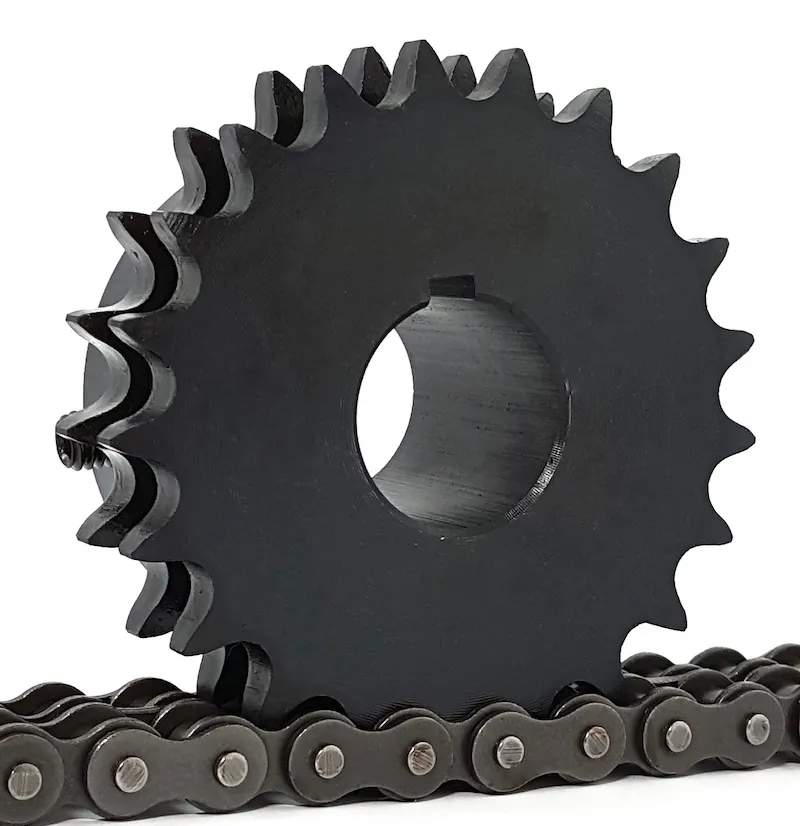
Product introduction
YZEFY Sprockets manufactures power transmission sprockets for new equipment, replacement drives and OEM production. We supply plate, hub, simplex, duplex, triplex, taper lock and QD configurations, with custom bores, keyways, materials and treatments where the design requires them.
Main uses
- Drive sprockets and driven sprockets for roller chain power transmission
- Single and multi-strand chain drives
- Speed reduction or speed increase through selected sprocket ratios
- Replacement of worn transmission sprockets
- Custom chain drive sprockets for OEM machinery
Suitable industries
Packaging, agricultural equipment, material handling, woodworking, food processing, mining and building materials equipment, and general machine manufacturing use transmission sprockets. The chain and sprocket pair should be reviewed together when the drive carries impact or runs continuously.
Core advantages
- Sprocket designs selected around chain engagement, ratio and shaft mounting
- Options for pilot, finished, taper lock and QD bores
- Material and treatment choices for different loads and environments
- Drawing and sample review for replacement and OEM drives
Product features
- Materials: C45 and 40Cr alloy steel are common for industrial power transmission. Stainless steel, cast iron, aluminum, nylon or acetal can be reviewed for corrosion, weight or other requirements.
- Machining: CNC turning, gear hobbing or milling, bore and keyway machining, hub work and deburring can be combined according to the sprocket design.
- Dimensional accuracy: Tooth pitch, tooth profile, pitch diameter, bore, keyway, hub, concentricity and runout are the main inspection points for chain drive fit.
- Surface treatment: Induction hardening, carburizing or a specified protective finish can be considered for wear, impact or corrosion exposure.
- Standards: ANSI, DIN, ISO, BS and JIS roller chain standards can be used as the production reference. Confirm the complete chain series.
- Custom capability: Driver and driven teeth, bore, keyway, hub, strand count, material, treatment and mounting details can be customized.
Applications
- Conveyor systems: Roller chain drive sprockets for continuous material movement
- Packaging machinery: Compact chain drives with defined speed and shaft spacing
- Agricultural equipment: Power transmission sprockets exposed to dust, impact and variable loads
- Food processing equipment: Stainless steel or protected sprockets where cleaning conditions require them
- OEM machinery: Custom transmission sprockets built into machine drawings
- Industrial maintenance: Replacement drive and driven sprockets for worn chain systems
Selection guide
- Confirm the chain. Provide chain standard, series, pitch, roller dimensions and strand count.
- Calculate the ratio. State input speed, target speed and driver/driven tooth counts, or ask for a ratio review.
- Check load and speed. Include torque, power, shock load, operating hours and duty cycle. These affect tooth and material selection.
- Confirm the shaft interface. Give shaft diameters, keyways, hub lengths, locking methods and chain line.
- Check alignment and center distance. Sprocket faces must run in the same plane and allow suitable chain wrap.
- Review the environment. State dust, moisture, washdown, corrosion, temperature and maintenance conditions.
Why choose YZEFY Sprockets
- Manufacturing capability: Our workflow covers tooth cutting, bore and keyway machining, hub work, heat treatment and dimensional inspection for transmission sprockets.
- Custom engineering support: We review the drive pair, ratio, chain and shaft interface rather than quoting the driver or driven sprocket in isolation.
- Quality control: Tooth profile, pitch diameter, bore, keyway, concentricity and runout can be checked against the agreed specification.
- Export experience: We coordinate matched sets, drawing revisions, packing and shipping details for standard and custom transmission orders.
FAQ
What is a drive sprocket?
A drive sprocket is connected to the power source and uses the chain to transmit motion to the driven sprocket. The actual designation depends on the chain, teeth, bore and mounting arrangement.
How do I calculate a sprocket ratio?
For a simple chain drive, divide the driven sprocket tooth count by the driving sprocket tooth count to estimate the speed ratio. Confirm the result against the required input speed, output speed and load.
Can a larger sprocket reduce chain wear?
A larger tooth count can change chain articulation and wrap, but the correct choice also depends on speed, load, center distance, chain size and available space. Do not select by diameter alone.
Do you supply both drive and driven sprockets?
Yes. Driver and driven sprocket pairs can be reviewed together so the tooth counts, chain line, bore and keyway match the machine.
Can you manufacture a power transmission sprocket from a drawing?
Yes. The drawing should include chain standard, teeth, pitch, bore, keyway, hub, material, treatment and tolerances. A sample or worn part can also start the review.
What information is needed for a replacement transmission sprocket?
Send the chain marking, tooth count, shaft diameter, bore, keyway, hub dimensions, current speed and application. Photos of the drive and the worn part can help identify the mounting arrangement.
Request a quote
Send the chain series, driver and driven teeth, shaft dimensions, bore, keyway, hub style, material, quantity and working conditions. Include the drive ratio or target speed when known. Use Request a Quote or Send Your Drawing.